
Product pages decide whether traffic turns into revenue. Yet many brands still treat them as catalog entries. Today, ecommerce seo marketing focuses on product pages because they sit closest to purchase intent and conversion.
However, visibility alone does not guarantee sales. Without strong ecommerce seo fundamentals, even high-traffic pages underperform. Therefore, brands increasingly partner with an ecommerce seo agency or a shopify seo agency to optimize product experiences end to end.
Moreover, competition has intensified across every category. A generic page rarely ranks or converts. This is why a modern seo agency for ecommerce or a seo ecommerce agency emphasizes structured, intent-driven product page optimization.
Why Product Page SEO Matters More Than Ever in Ecommerce SEO Marketing
Search engines now prioritize pages that satisfy user intent quickly. Therefore, product pages must deliver clarity, trust, and speed.
According to Google, helpful content improves rankings and engagement. This means product pages must go beyond basic descriptions.
Brian Dean once joked, “If your content is boring, even Google gets sleepy.” While humorous, it highlights a serious issue.
Therefore, engaging product pages not only rank better but also convert better. They align information with decision-making.
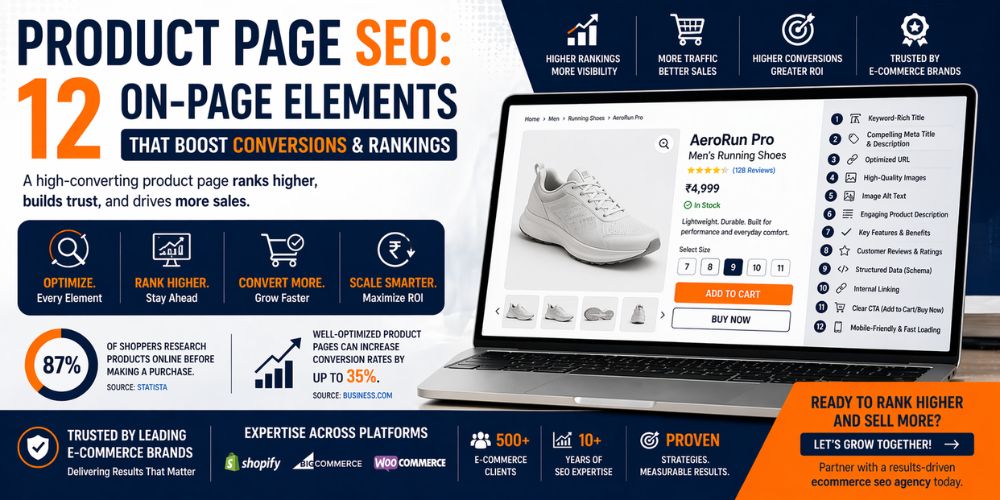
The 12 On-Page Elements That Drive Rankings and Conversions
1. Keyword-Optimized Product Titles That Match Intent
Product titles should reflect how users search. Avoid internal naming conventions. Instead, use descriptive, keyword-rich phrases.
2. Compelling Meta Titles and Descriptions
Meta elements influence click-through rates. Therefore, write persuasive descriptions that highlight value and urgency.
3. High-Quality Product Descriptions
Unique descriptions improve rankings and trust. Avoid duplicate manufacturer content. Instead, focus on benefits and use cases.
A study by Nielsen Norman Group shows users scan content quickly. Therefore, structure content for readability.
4. Optimized URL Structure
Clean URLs improve usability and SEO. Include primary keywords while keeping URLs concise.
5. Image Optimization and Alt Text
Images influence both engagement and SEO. Use high-quality visuals and descriptive alt text to capture search visibility.
6. Product Schema Markup
Structured data enhances search results. Rich snippets increase click-through rates and visibility.
7. Internal Linking to Category and Related Products
Internal links guide users and search engines. They distribute authority across important pages.
8. Customer Reviews and User-Generated Content
Reviews build trust and improve rankings. They also add fresh content to pages.
According to BrightLocal, 87% of consumers read online reviews before purchasing.
9. Clear Pricing and Availability Information
Transparency reduces friction. Therefore, display pricing and stock status clearly.
10. Strong Call-to-Action Placement
CTAs should stand out visually. However, they must also align with user intent.
11. Page Speed and Mobile Optimization
Speed impacts both rankings and conversions. Google confirms that faster pages improve user experience.
12. Trust Signals and Security Indicators
Trust badges, return policies, and guarantees increase confidence. Therefore, they directly influence conversions.
Data Insight: What Impacts Product Page Performance
| Factor | Impact on Rankings | Impact on Conversions |
|---|---|---|
| Content Quality | High | High |
| Page Speed | High | High |
| Reviews | Medium | Very High |
| Structured Data | Medium | Medium |
Source: Insights from Google, Ahrefs, and conversion optimization studies.
Technology Layer: Scaling Ecommerce SEO Marketing
Modern ecommerce demands scalability. Manual optimization cannot handle thousands of SKUs.
Therefore, leading teams use automation and data-driven systems. AI-driven keyword clustering identifies opportunities. Log file analysis reveals crawl behavior.
Tools like Google Search Console and Screaming Frog enable continuous optimization.
Moreover, headless commerce architectures improve performance and flexibility. They allow better control over SEO elements.
Real-World Perspective: What High-Performing Brands Do Differently
Top ecommerce brands treat product pages as conversion assets. They invest in design, content, and technical performance.
As Jeff Bezos once said, “We see our customers as invited guests to a party.” This mindset reflects in product page experience.
Additionally, brands that continuously test and optimize elements outperform competitors consistently.
Conclusion: Product Pages Are Your Final Conversion Lever
Product page SEO is not optional. It directly impacts revenue and growth.
When content, UX, and technical SEO align, product pages perform at scale. Therefore, investing in ecommerce seo marketing, supported by a strong ecommerce seo agency, experienced shopify seo agency, and a reliable seo agency for ecommerce or seo ecommerce agency, creates a measurable competitive advantage.
Ready to turn product pages into high-converting assets? Build a strategy that combines visibility, trust, and performance for long-term success.