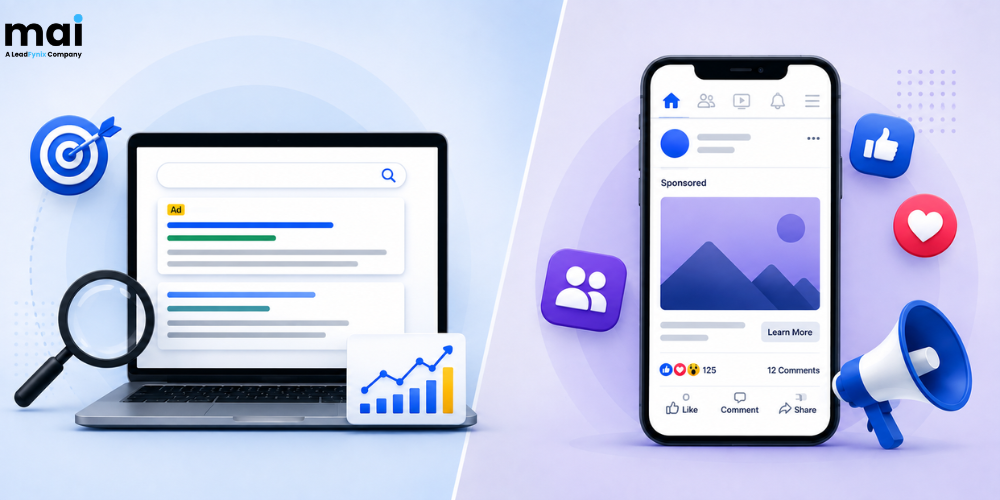

If you’ve got a limited ad budget and a growing business, you’ve probably asked yourself this question at least once: should you put your money into Google Ads, or into Facebook and Instagram? The paid search vs paid social debate isn’t new, but it still trips up a lot of business owners — mostly because both channels get lumped together as “paid ads” when they actually do very different jobs.
The short answer is that paid search and paid social aren’t really competing for the same job. One captures demand that already exists. The other creates demand where it doesn’t exist yet.
Honestly, the answer isn’t about which channel is “better” — it’s about where your business is right now. Are people already searching for what you sell? How much budget do you actually have to experiment with? And how fast do you need results — next week or next quarter?
Let’s get into what each channel really does, what the numbers actually show, and how you can figure out where your first rupee should go.
What Is Paid Search?
Paid search — often called PPC or SEM — refers to ads that show up on search engine results pages, mainly through Google Ads. These ads can appear when someone’s search matches the keywords you’re targeting. When someone types “best CRM software for small business” or “AC repair near me,” a paid search ad can appear right above the organic results.
The defining feature of paid search is intent. A search query is usually a stronger signal of active interest than a social-media impression. If someone is searching for your product or service, they’re already somewhere in the buying journey — sometimes very close to the end of it.
What Is Paid Social?
Paid social basically means ads on platforms like Meta (Facebook and Instagram), LinkedIn, and YouTube. Unlike search, nobody has to type anything for these ads to show up — they’re just placed in front of the right kind of person, based on their demographics, interests, and behavior online.
Paid social works on interruption, not intent. It puts your ad in front of someone scrolling their feed who may not be thinking about your product at all yet. That’s not a weakness; it’s a different job. Paid social is built to introduce people to something they didn’t know they needed, or to stay top-of-mind until they’re ready to act.
The Core Difference: Capturing Demand vs. Creating Demand
This is really the heart of the paid search vs paid social decision:
- Paid search captures demand that already exists It’s reactive — you show up when someone raises their hand.
- Paid social creates or nurtures demand: It’s proactive — you’re trying to get someone’s attention before they’ve started actively looking.
This difference shows up clearly in performance data. According to a 2026 benchmark study by Ruler Analytics, which analyzed more than five million conversions across 13 industries, paid search had an average conversion rate of 5.4%, the highest of the marketing channels measured in its dataset. That makes sense given the intent behind search: people typically see these ads after actively looking for a product, service, or solution.
Paid social often plays a different role. A 2026 e-commerce benchmark analysis by Eightx puts paid social conversion at around 1.1%, showing how social traffic can convert differently from higher-intent search traffic.
That gap doesn’t mean paid social is a poor investment — it means it’s measuring a different stage of the funnel. Someone clicking a Google Ads listing has already decided they have a need. Someone clicking a Facebook ad might be encountering your brand for the first time.
When Paid Search Should Come First
Paid search is usually the smarter starting point if:
- People are already searching for what you offer: If there’s meaningful search volume around your product or service category, that demand exists whether you advertise or not — you’re just deciding whether to capture it or let a competitor do it.
- You’re in a high-intent, transactional category: Home services, healthcare, legal, real estate and other “I need this now” categories can be well suited to search because people often turn to Google when they’re actively looking for a solution.
- You need faster, more measurable results: Because search ads reach people who have already shown intent, they can often generate results faster than channels focused primarily on awareness.
- Your budget is limited. A tightly targeted search campaign can make better use of a small budget when there is enough search demand, because you’re concentrating your spend on people already looking for a relevant product or service.
When Paid Social Should Come First
Paid social makes more sense as the priority when:
- You’re launching something new: If your product or service doesn’t have an established search demand yet — because people don’t know it exists — search can’t capture demand that isn’t being expressed. Social can introduce the idea.
- Visual storytelling matters to your product: Fashion, food, home decor, fitness, and lifestyle brands often perform better with the highly visual, scroll-stopping formats social platforms offer.
- You’re targeting a very specific audience profile: Social platforms allow specific audience targeting based on job title, interests, behaviors, and life stage — useful for B2B account-based targeting on LinkedIn or niche consumer segments on Meta.
- Brand awareness and top-of-funnel reach are the current priority, not immediate conversions.
Why the “Which One First” Question Sometimes Misses the Point
In practice, many mature marketing programs eventually run both — because search and social aren’t really rivals, they’re different parts of the same customer journey. A person might first notice your brand through an Instagram ad, ignore it, then a few weeks later search for your product by name on Google and convert through a search ad. If you only measure the search ad, you might assume social contributed nothing — when it may have been the reason the search happened at all.
That said, if you genuinely have to choose one channel to start with — because of budget, team bandwidth, or timeline pressure — the deciding question is simple: is there already search demand for what you offer? If yes, start with search and capture it. If no, or if you’re trying to build awareness before demand exists, paid social is the more logical entry point.
A Practical Way to Decide
If you’re still unsure, ask yourself these three questions:
- Would someone actively type a search query for what I sell? If yes, there is already some level of search demand — and paid search may be the better place to start.
- Do I need leads in the next 30 days, or am I building for the next 6–12 months? If there’s already demand out there, search can get you results pretty quickly. Social usually takes longer, since you’re building awareness first and giving the algorithm time to gather enough data to actually optimize.
- Is my product something people discover, or something people look for? Discovery-driven products, such as new categories, lifestyle products, and impulse purchases, can be a natural fit for social. Need-driven products, such as repairs, professional services, and other high-intent purchases, often lean toward search.
There’s no universal right answer — the right starting channel depends on your category, your audience’s buying behavior, and how much runway you have to test and learn.
A Quick Example
Say you run a home renovation business in Pune. People searching “kitchen renovation contractor near me” already know they need the service — they just need to find someone. That’s a textbook paid search situation: high intent, transactional, and time-sensitive. Starting with Google Ads would generally be the stronger choice here because you’re reaching people at the exact moment they’re actively looking for a solution.
Now compare that to a new D2C skincare brand launching a product that people haven’t heard of yet. There may be little or no search demand for the specific product or brand at first. In this case, paid social — with strong visuals, influencer-style content, and audience targeting — can help create initial awareness and interest. As more people become familiar with the brand, paid search can become useful for capturing people who later search for it directly.
Same underlying question — “should I run paid search or paid social” — but two very different answers, because the businesses sit in different places on the demand curve.
Getting the Strategy Right Matters More Than the Platform
Whichever channel you start with matters less than you’d think. The real risk isn’t picking the “wrong” one — it’s running ads without a solid plan connecting your audience, your message, and where you actually send people. You can nail the targeting on a search campaign, but a weak landing page will still underperform it. And a beautifully designed social ad won’t mean much either if there’s no retargeting or search follow-up to catch the demand it just created.
This is where working with a team that treats paid search and paid social as one connected acquisition strategy — rather than two separate line items — tends to produce better results than running either channel in isolation.
If you’re still unsure about this for your own business, it might be worth talking to people who work with paid advertising every day. MAI works with businesses across India to figure out whether search, social, or both make sense based on their industry, audience, and existing demand. There’s no fixed formula — the right starting point depends on where your business stands and where your customers are in the buying journey.