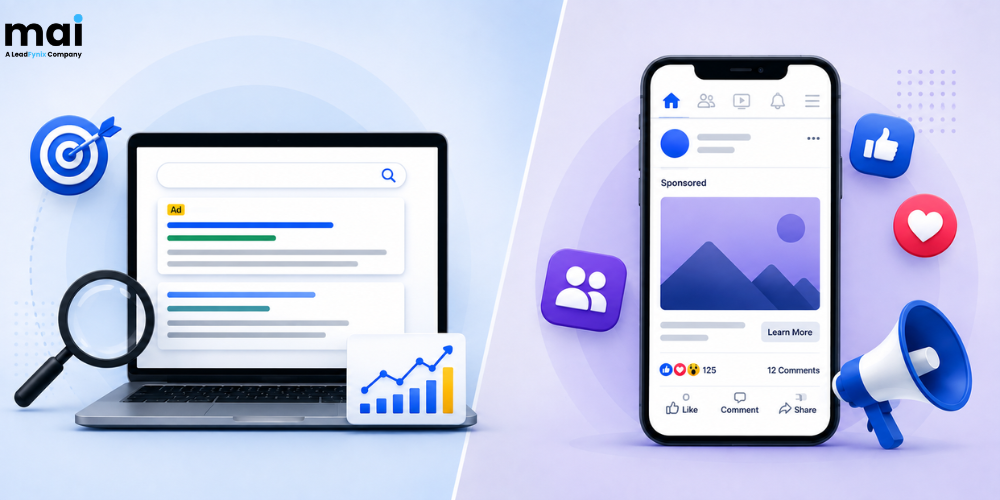
If you’re trying to grow your business online, sooner or later you’re going to ask yourself the same question: Google Ads or Facebook Ads — where should you actually spend your money? The truth is, there’s no simple answer. Both platforms work differently and attract people at different stages of the buying process. Choose the wrong one for your business, and you could end up spending weeks on ads that get clicks but barely bring in any real leads.
Here’s a look at how each one actually works, what kind of leads you can expect from each, and how to figure out which one makes sense for your business.
Google Ads catches people who are already looking
Here’s the thing about Google Ads — your ad appears when someone is already searching for a product, service, or solution. They might search for “best CRM for real estate agents,” “affordable web developer near me,” or “dentist near me.” These people aren’t just browsing. They’re looking for something specific, and your ad needs to be there when they’re ready to find it.
That’s what makes Google such a solid bet for lead generation. They weren’t just casually browsing. They searched for something they needed, and your ad showed up with an answer.
WordStream’s Google Ads benchmark report, which looked at over 13,000 search campaigns, found an average conversion rate of 8.18% across industries, with cost per click sitting around $5.42 and cost per lead around $66.69. Of course, these numbers can vary a lot by industry. Legal and insurance campaigns tend to be more expensive, while businesses such as repair services and pet care may see lower lead costs. Google’s own Ads documentation explains that Search campaigns can show ads to people actively searching for products and services.
Where Google Ads gets tricky is cost. You’re bidding against everyone else who wants the same keywords, so prices in crowded industries can get expensive fast. But when those clicks come from people who are already close to making a decision, the higher cost can still be worth it.
Facebook Ads creates interest instead of waiting for it
Facebook Ads, part of Meta’s advertising platform, play a totally different game. Nobody’s searching for you. You’re the one popping up in someone’s feed while they’re watching Reels, scrolling through posts, or catching up with friends. You’re not catching demand, you’re creating it.
This is why Facebook tends to work so well for businesses that live and die by visuals — interior design, fitness coaches, real estate listings, fashion brands, anything where a good photo or video does the selling. And in many campaigns, it can be cheaper on a click-for-click basis than Google.
WordStream’s Facebook Ads benchmark data shows lead generation campaigns averaging around $1.92 per click and $27.66 per lead — noticeably less than what you’d pay on Google. You can also get very specific with targeting, using factors such as age, location, interests, and other available audience signals. Meta’s own advertising page explains how businesses can reach people based on factors such as their interests, location, and other audience signals, rather than relying on what they’re actively searching for.
The catch is that these leads need more convincing. Someone scrolling past your ad hasn’t decided anything yet — they might not even know they have the problem your product solves. You’ll usually need a follow-up sequence, a retargeting ad or two, maybe a phone call, before that interest turns into an actual sale.
So what’s the real difference?
If I had to sum it up in one line: Google Ads catches people who already want something, Facebook Ads convinces people they want something.
Say someone’s AC breaks down in June. They’re not scrolling Instagram looking for repair inspiration — they’re Googling “AC repair near me” and calling whoever answers first. That’s Google’s territory. Now think about someone who wasn’t planning to redecorate their living room until they saw a gorgeous sofa on their feed. That’s Facebook doing its job.
Businesses where people already know they have a problem and are actively looking for a fix — law firms, clinics, plumbers, software companies — usually do better on Google. Businesses selling something people didn’t know they wanted yet — clothing, home décor, online courses, subscription boxes — tend to do better on Facebook.
Here’s a quick comparison of Google Ads and Facebook Ads, including their average CPC and CPL figures:
| Google Ads | Facebook Ads | |
|---|---|---|
| How it reaches people | Shows up when someone actively searches for a solution | Shows up while someone is scrolling, based on interests and behavior |
| Average cost per click | Around $5.42 | Around $1.92 |
| Average cost per lead | Around $66.69 | Around $27.66 |
| Lead readiness | Closer to a buying decision | Usually needs more nurturing |
| Best fit | Services people search for by name (legal, healthcare, home repair, software) | Visual products and brand building (fashion, décor, courses, real estate listings) |
| Targeting style | Based on search keywords and intent | Based on age, interests, job title, location, behavior |
Picking one (or honestly, maybe both)
Really depends on where your customers already are in their thinking.
If you’re running a home services company, a clinic, a law firm — anything where people search for the exact problem they have — start with Google. The intent is already sitting there waiting for you to grab it.
If you’re launching something new, building a brand, or selling something people don’t yet realize they need, Facebook can get you cheaper leads and build up an audience over time.
Plenty of businesses don’t pick one and call it done — they run both. Facebook builds awareness and warms people up, Google catches that same audience once they start actively looking. This combo often beats running either platform alone, especially in industries with a longer decision process — real estate, BFSI, high-ticket B2B deals.
A few things that matter no matter which platform you pick
- Your landing page carries half the weight. A great ad sending people to a slow, cluttered, or mismatched page is money wasted.
- Lead quality beats lead count. Thirty leads who actually respond are worth more than two hundred who ghost you.
- Watch cost per lead, not just cost per click. A cheap click that never turns into a lead isn’t actually cheap.
- Give campaigns time before judging them. Both platforms need a bit of runway to gather enough data to perform well.
Final Thoughts
There’s no clean winner in the Google Ads vs Facebook Ads debate — it really comes down to what your customers want and how ready they are to buy. Google works best when people already know what they want and are looking for it right now. Facebook works best when you need to plant that idea in someone’s head in the first place. Your industry, your sales cycle, and how “ready to buy” your typical customer is when they first hear of you should decide where your money goes.
If you’re still not sure which platform to use, or you’d rather run both channels together instead of guessing your way through it, MAI can help build a performance marketing plan around your actual business — not a generic template that ignores what makes your industry different.