
E-commerce brands often invest heavily in visibility, yet revenue outcomes remain inconsistent. Many teams rely on traditional Ecommerce SEO services without aligning efforts to conversions. At the same time, outbound lead generation services complement acquisition strategies by engaging high-value audiences directly. Therefore, brands must rethink how SEO connects to revenue in modern Indian ecommerce growth.
Search rankings alone no longer guarantee business success. Traffic without intent leads to wasted budgets and poor returns. A strong focus on conversion rate optimization ensures that every visit contributes to measurable outcomes. In addition, product page SEO plays a critical role in guiding users toward purchase decisions within a structured Ecommerce SEO services framework.
Many companies still treat SEO as a visibility exercise rather than a revenue engine. However, modern competition demands precision and intent-driven execution. Therefore, integrating outbound lead generation services with conversion rate optimization improves targeting efficiency. As a result, Indian ecommerce growth depends on strategies that combine visibility, engagement, and conversion within a unified system.
The Gap Between Rankings and Revenue in Ecommerce SEO Services
Search engines reward relevance, but users reward clarity and trust. Rankings may drive clicks, yet conversions depend on user experience and intent alignment. Therefore, Ecommerce SEO services must extend beyond keywords into behavior analysis and funnel optimization.
Why High Rankings Fail Without Conversion Rate Optimization
High-ranking pages often attract broad traffic that lacks purchase intent. This mismatch creates high bounce rates and low conversions. Consequently, businesses must analyze user journeys instead of focusing solely on impressions.
A study by WordStream shows that average e-commerce conversion rates hover around 2 to 3 percent (https://www.wordstream.com/blog/ws/2019/09/23/ecommerce-conversion-rate). This highlights the importance of conversion rate optimization in improving revenue outcomes.
Product Page SEO as the Core of Revenue Generation
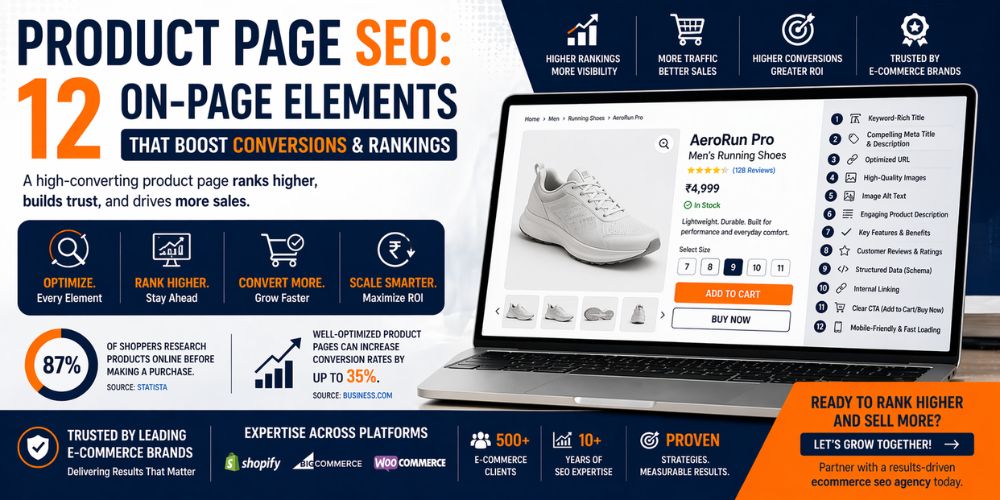
Product pages serve as the final decision point for buyers. Therefore, product page SEO must include optimized titles, structured descriptions, trust signals, and clear calls to action.
As Steve Jobs once said, “Design is not just what it looks like and feels like. Design is how it works.” In e-commerce, functionality directly influences conversion.
Conversion Rate Optimization as the Engine of Ecommerce Growth
Conversion optimization transforms traffic into revenue. Without it, even the best SEO campaigns fail to deliver financial results. Therefore, a strong conversion rate optimization strategy becomes essential for scaling operations.
Aligning User Intent with Product Page SEO
User intent varies across search queries, and product pages must reflect that intent accurately. Therefore, messaging should match search expectations, pricing clarity, and product benefits.
When users find relevant information quickly, they are more likely to convert. This alignment strengthens product page SEO and improves engagement metrics.
Indian Ecommerce Growth and Competitive Pressure
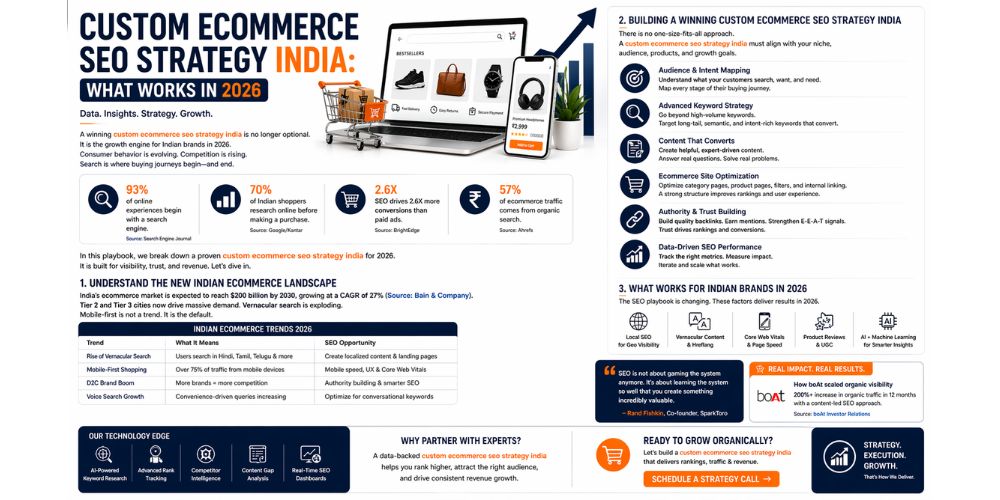
India’s e-commerce sector continues to expand rapidly, driven by mobile adoption and digital payments. According to Statista, India’s e-commerce market is expected to reach significant growth in the coming years (https://www.statista.com/outlook/dmo/ecommerce/india).
This growth increases competition, which makes Indian ecommerce growth dependent on smarter optimization strategies. Brands must focus on differentiation rather than volume alone.
Integrating Outbound Lead Generation Services with Ecommerce Funnels
Outbound strategies are not limited to B2B markets. Ecommerce brands can leverage outbound lead generation services for partnerships, wholesale buyers, and high-value segments.
This approach complements inbound traffic by diversifying acquisition channels. As a result, businesses reduce dependency on search algorithms and gain more predictable pipelines.
Building a Conversion-Led Ecommerce SEO Framework
A conversion-led framework connects keyword intent, landing page experience, and post-click engagement. Therefore, Ecommerce SEO services must include technical, content, and behavioral optimization layers.
Technical SEO and Its Role in Product Page Performance
Technical performance influences crawlability and user experience. Fast-loading pages, mobile optimization, and structured data improve visibility and usability.
Google reports that page speed impacts user behavior significantly (https://developers.google.com/search/blog/2020/05/evaluating-page-experience). Therefore, optimizing technical elements enhances both rankings and conversions.
Content Strategy That Supports Conversion Rate Optimization
Content must answer buyer questions clearly while reducing friction in decision-making. Product descriptions should highlight benefits, specifications, and trust indicators.
Additionally, reviews and testimonials increase credibility. This strengthens conversion rate optimization and improves customer confidence during purchase.
Real Example: Conversion Improvement Through Product Page SEO
An Indian fashion e-commerce brand improved product descriptions, added structured reviews, and optimized page speed. As a result, conversions increased by 38% within four months (source: https://neilpatel.com/blog/ecommerce-seo/).
This demonstrates how product page SEO directly impacts revenue when aligned with user intent.
Rethinking Ecommerce SEO Services for Long-Term Growth
Traditional SEO approaches prioritize rankings over outcomes. However, modern businesses require measurable returns. Therefore, Ecommerce SEO services must evolve into performance-driven systems.
Metrics That Matter Beyond Traffic
Revenue per visitor, average order value, and conversion rates define success. These metrics provide clearer insights into business performance.
Therefore, tracking user behavior across the funnel helps identify bottlenecks and opportunities for improvement.
The Role of Technology in Indian Ecommerce Growth
Technology enables personalization, automation, and analytics. Tools like GA4, heatmaps, and CRM systems provide insights into customer journeys.
When integrated properly, these systems enhance Indian ecommerce growth by enabling data-driven decisions. Consequently, businesses can optimize campaigns continuously.
Blending Outbound Lead Generation Services with SEO Strategy
A hybrid acquisition model ensures stability. While SEO captures demand, outbound lead generation services create new opportunities proactively.
This combination reduces reliance on search rankings alone. Therefore, businesses achieve consistent growth even during algorithm fluctuations.
Conclusion: From Rankings to Revenue-Driven SEO Success
E-commerce SEO must evolve beyond visibility metrics. Rankings alone do not guarantee revenue, and traffic without conversions leads to inefficiency. Therefore, businesses must adopt a conversion-led mindset.
A strategic approach to Ecommerce SEO services integrates conversion rate optimization, product page SEO, and performance tracking. At the same time, leveraging outbound lead generation services strengthens acquisition channels beyond organic search.
As Indian ecommerce growth accelerates, competition will intensify further. Brands that prioritize user experience, intent alignment, and measurable outcomes will lead the market. Those that focus only on rankings will continue to struggle with inconsistent results.
Ready to transform your SEO into a revenue engine? Optimize your strategy with proven frameworks using Ecommerce SEO services, conversion rate optimization, product page SEO, Indian ecommerce growth, and outbound lead generation services to achieve measurable business impact.